SERA / TAZENQOR
Inspect the edit.
Keep the evidence.
Three small, reproducible software examples: a transposition, a dynamic edit and a refusal.
Run on 18 October 2026 with the local rule provider and project-generated synthetic fixtures. These examples demonstrate software behavior; they do not measure general LLM accuracy, musical quality or an independent composer study.
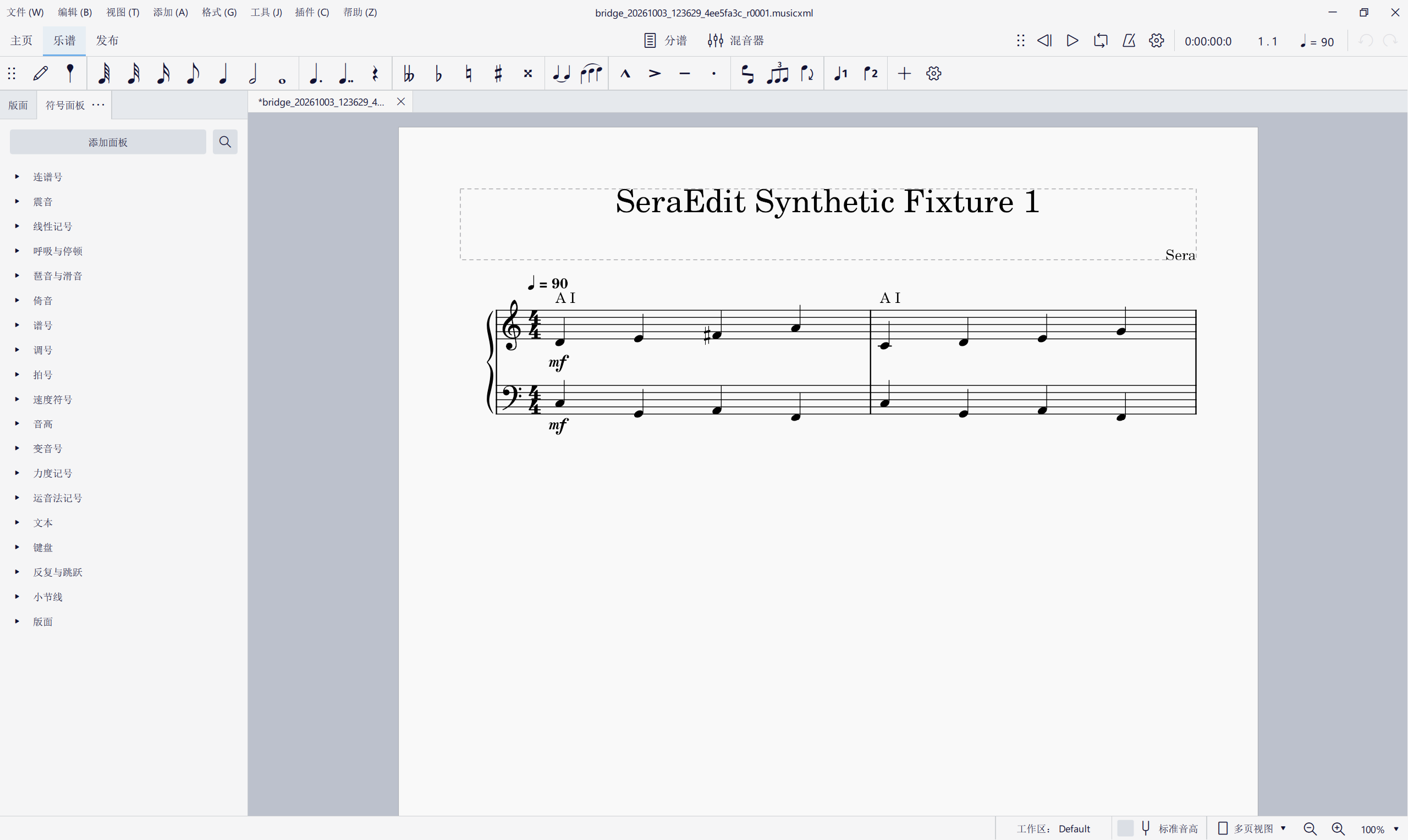
01 / Transpose a selected measure
Transpose measure 1 of staff 1 up by a major second while preserving rhythm.
| Event | Field | Before | After |
|---|---|---|---|
m1_rh_1 | pitch | C4 | D4 |
m1_rh_2 | pitch | D4 | E4 |
m1_rh_3 | pitch | E4 | F#4 |
m1_rh_4 | pitch | G4 | A4 |
The selected run passed its task checks and preservation checks; the revision was re-imported as valid MusicXML.
02 / Change one dynamic
Change only the third note in measure 1 to forte, preserving pitch and duration.
| Event | Field | Before | After |
|---|---|---|---|
m1_rh_3 | dynamic | mf | f |
The selected run passed its task checks and preservation checks; the revision was re-imported as valid MusicXML.
03 / Refuse a conflicting request
Change measure 1 to 5/8 while preserving every note duration and leaving no rests.
The local rule provider refused the request: changing meter while preserving every note duration exceeds its safe subset. No revised score was produced.
View a revision in notation software
Provenance & reproduction
Scores and benchmark tasks are project-generated CC0-1.0 fixtures, not excerpts of commercial repertoire. The public source includes scripts/run_reviewer_demo.py; select pitch_001, dynamics_001 and conflict_001 in local mode.